

Forensic Audit Report · November 2026 · Last verified: 13 November 2026
Is Wikipedia Credible Today? 12 Documented Contradictions in Wikipedia’s Own Policies
Wikipedia is a useful starting point for general research. It is not reliable as a final source for academic, medical, legal, or professional work — and Wikipedia itself says so in its own General Disclaimer and Medical Disclaimer. The 12 contradictions in this audit are not edge cases. They are direct conflicts between what Wikipedia says in one place and what it says in another — on the same domain, often in the same document.
- 12 Findings
- Medical · Privacy · AI · Bias
- GDPR · FTC · EU DSA · AI Act
- Live Screenshots · November 2026
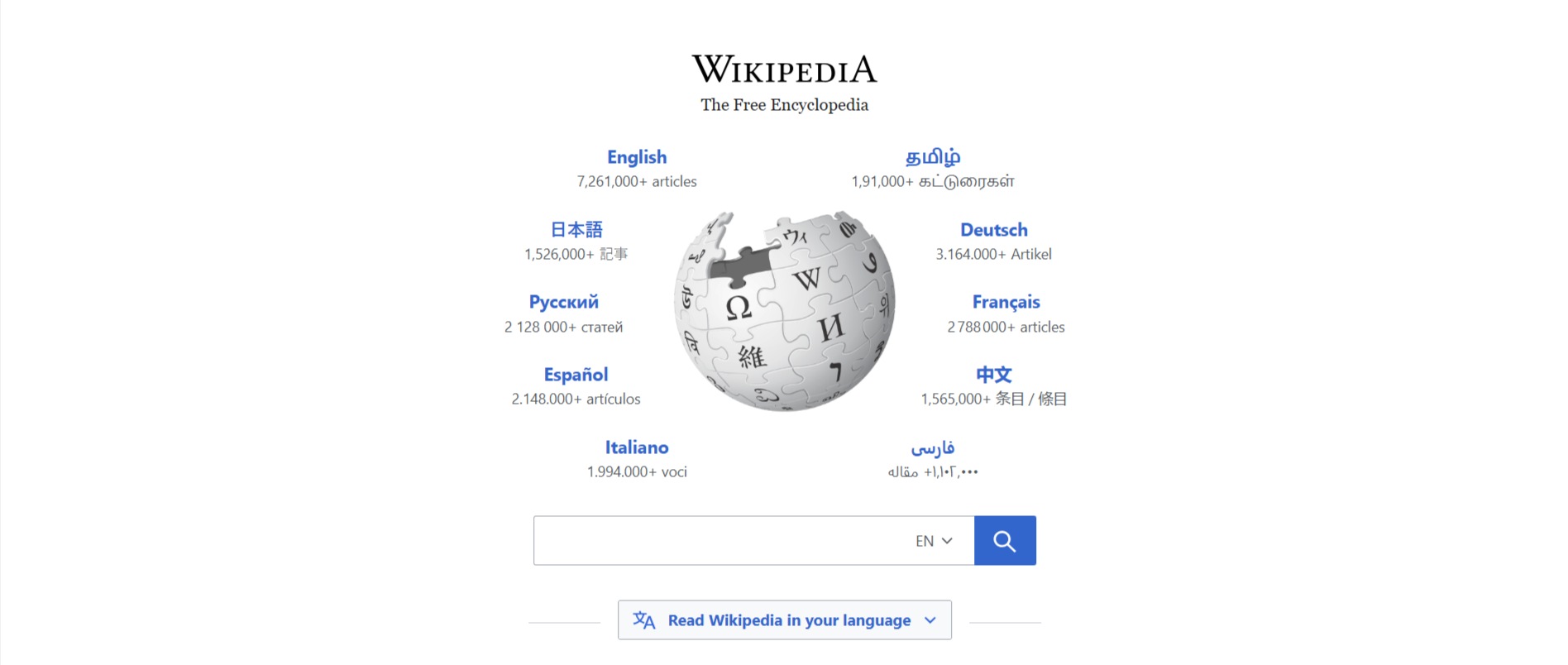
Image: Wikipedia.org homepage screenshot, November 2026. Wikipedia® is a registered trademark of the Wikimedia Foundation. Wikipedia text: respective contributors, under CC BY-SA 4.0 where applicable; logos and other media retain their separate rights. Used here as documentary evidence for criticism and analysis. No affiliation or endorsement. Screenshot credits & publication notice.
All 12 Findings at a Glance
Each finding is a direct conflict between two statements on Wikipedia’s own domain. Click any finding below to read the full analysis and screenshots.
| # | Topic | Severity | Wikipedia Says | But Also Says / Law Says | Verdict | |
|---|---|---|---|---|---|---|
| 1 | Who can edit | CRITICAL | “Anyone can edit” | Same page: “except in limited cases in which editing is restricted” | Tagline incomplete without exception | |
| 2 | Expert review | HIGH | “Quality of content is more important than the expertise of who contributes it” | General Disclaimer: “nothing found here has necessarily been reviewed by people with the expertise required” | Quality promised, expertise review not required | |
| 3 | Medical accuracy | CRITICAL | “Experienced editors watch and patrol bad edits” | Medical Disclaimer: “absolutely no assurance… non-professionals” | Comprehensive claim, zero medical warranty | |
| 4 | AI and bots | CRITICAL | “Written by human volunteers known as Wikipedians, not artificial intelligence” | 2,859 approved bot tasks. March 2026 LLM ban implies AI was getting in. | Automation existed before the AI ban | |
| 5 | Editorial bias | HIGH | UCoC bans “deliberately introducing biased, false, inaccurate or inappropriate content” | Reliability article: “facilitates multiple systemic biases… ideological bias on conscious and subconscious levels” | Policy targets intent, not structure | |
| 6 | Third-party data | CRITICAL | “Never selling your information or sharing it with third parties” | Same document: “We disclose Personal Information to our third-party service providers” | “Never” qualified by the same document | |
| 7 | Do Not Track | HIGH | “Strongly committed to protecting Personal Information” | Same document: “do not change our behavior in response to a web browser’s ‘do not track’ signal” | Commitment claimed, DNT signal ignored | |
| 8 | Right to erasure | CRITICAL | “Creating a permanent, public record of every piece of content added” | GDPR Article 17: right to erasure without undue delay | Permanent promise vs. legal erasure right | |
| 9 | Data retention | CRITICAL | “Personal Information is deleted after 90 days” | Same document: “permanent, public record” of contributions | 90-day promise, permanent reality | |
| 10 | IP address exposure | HIGH | “Edit without registering an account… without providing a real name” | IP address is Personal Information. Pre-Nov 2025 edits permanently public. Admins can still see IPs. | Anonymous editing with traceable IP | |
| 11 | TikTok pixel | CRITICAL | “We will never use third-party cookies on our wikis unless we get your permission to do so” | Same document: “Wikipedia Store… includes a tracking pixel from TikTok” | “Never” on wikis, pixel in the Store | |
| 12 | Cookie requirement | HIGH | “Cookies are not required in order to read or edit” | Same paragraph: “Cookies are required in order to login” | Both true, neither explains the other |
Full Audit: 12 Findings With Screenshots & Law Citations
Each finding shows the exact quoted text from two Wikipedia policy pages, a live screenshot of each, a plain-language scenario explaining the conflict, the applicable law, a real-world regulatory precedent, and a recommended fix. All policy quotes are from November 2026.
Finding 1 of 12: Can anyone edit Wikipedia — or is that claim misleading?
Wikipedia Says — Wikipedia:About
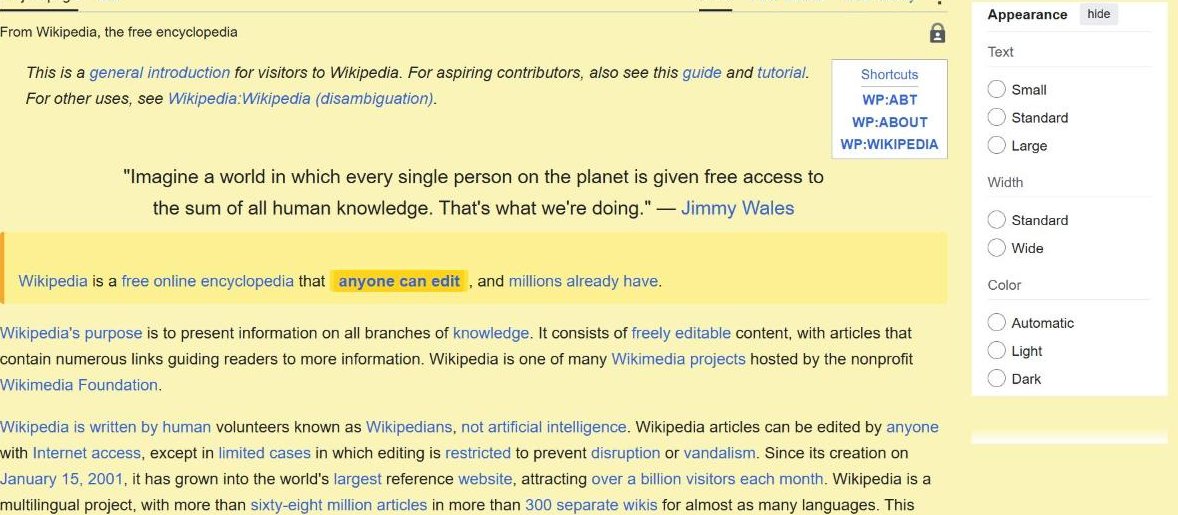
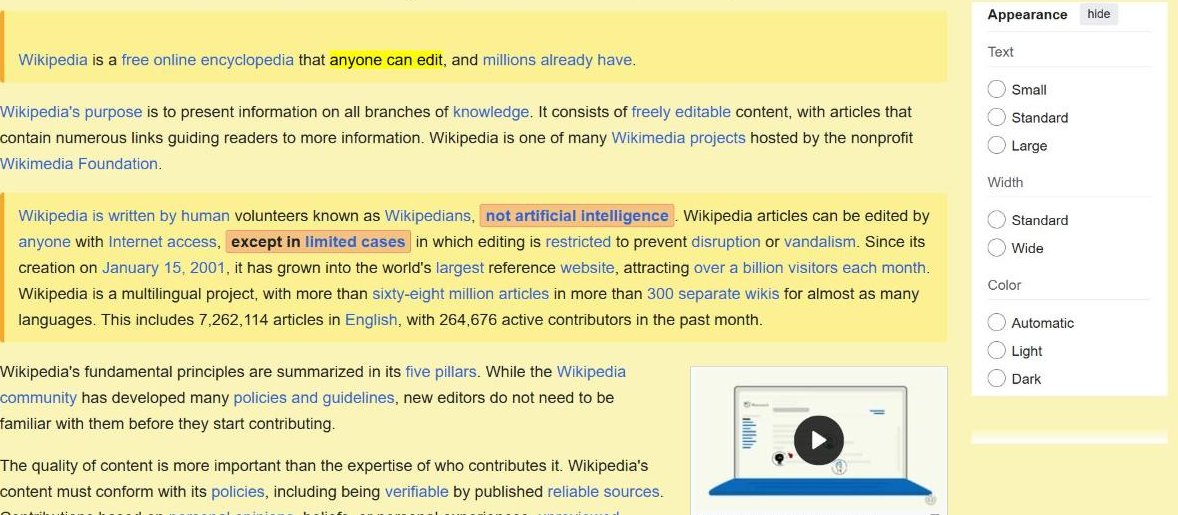
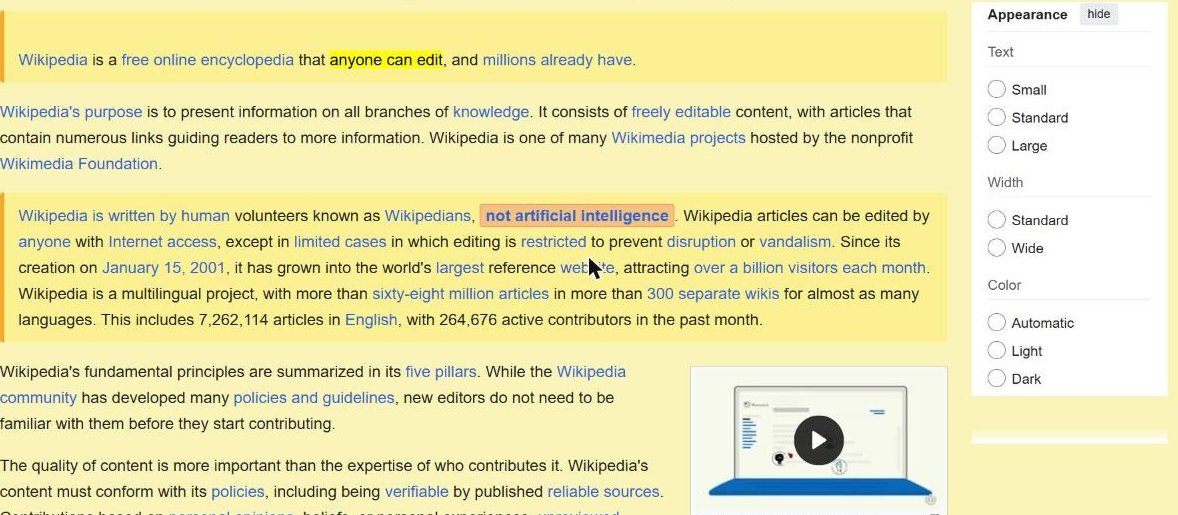
“Wikipedia is a free online encyclopedia that anyone can edit, and millions already have.”
But This Contradicts — Wikipedia:About
“Wikipedia articles can be edited by anyone with Internet access, except in limited cases in which editing is restricted to prevent disruption or vandalism.”
Why It Conflicts
A parent wants to correct a factual error in an article about their child’s school. They click “Edit.” Nothing happens — the article is semi-protected. To edit a semi-protected page, you must have an “autoconfirmed” account: at least 4 days old with at least 10 edits. Fully protected pages can only be edited by administrators. The tagline said “anyone can edit.” The same paragraph said “except in limited cases.” The parent is not told any of this upfront — they discover it only when their edit is blocked. Thousands of high-traffic articles on health, politics, and controversial topics are protected by default.
Who is affected: Anyone who attempts to fix an error on a popular or controversial Wikipedia article and discovers they cannot — without knowing they need an account age and edit count first.
Law / Governance at Risk
FTC Act Section 5 (15 U.S.C. § 45) — unfair or deceptive acts or practices — deceptive omission of a material limitationGDPR Article 5 — accuracy, purpose limitation & storage limitation — accuracy principle
Pages Involved
Wikipedia:About (single page, two lines)Finding 2 of 12: Is Wikipedia peer-reviewed — does it guarantee any review by experts?
Wikipedia Says — Wikipedia:About
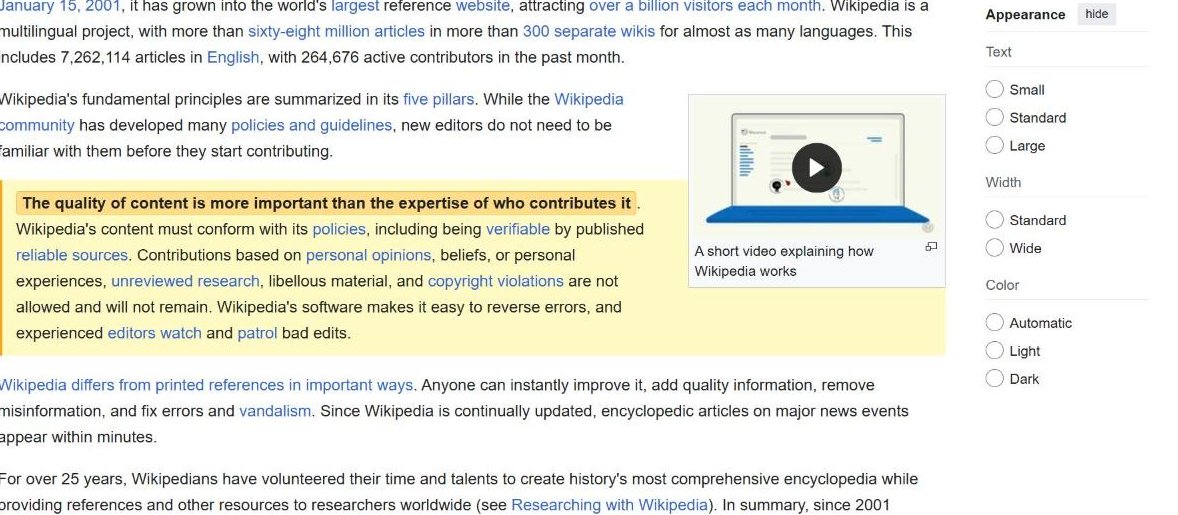
“The quality of content is more important than the expertise of who contributes it.“
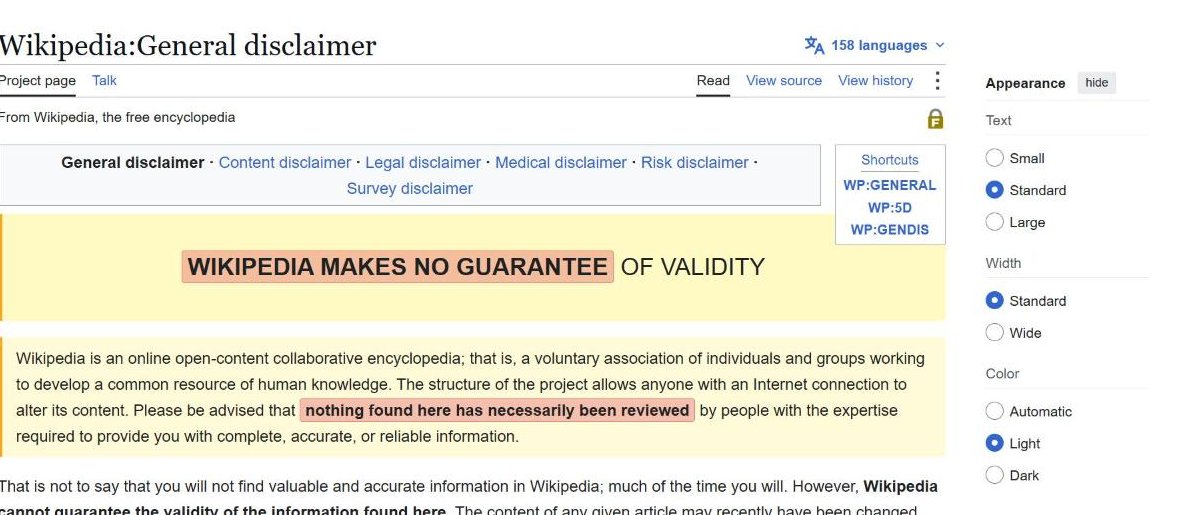
But This Contradicts — Wikipedia:General Disclaimer
“nothing found here has necessarily been reviewed by people with the expertise required to provide you with complete, accurate, or reliable information.”
Why It Conflicts
A student is writing a college paper on quantum mechanics. They find a detailed Wikipedia article, check the citations, and decide it looks credible. The About page said “quality of content is more important than expertise” — implying a quality standard exists. What they don’t see: the General Disclaimer says “nothing found here has necessarily been reviewed by people with the expertise required.” There is no peer-review process. There is no requirement that anyone with a physics background ever read that article. The quality claim implies someone checked. The disclaimer reveals nobody had to.
Who is affected: Students, academics, and professionals who assume Wikipedia content has been reviewed for accuracy before it was published, particularly on technical, scientific, or legal topics.
Law / Governance at Risk
GDPR Article 5 — accuracy, purpose limitation & storage limitation — accuracy principleFTC Act Section 5 (15 U.S.C. § 45) — unfair or deceptive acts or practices — implied quality-review claim without disclosed limitation
Finding 3 of 12: Is Wikipedia reliable for medical information — or written by non-professionals?
Wikipedia Says — Wikipedia:About
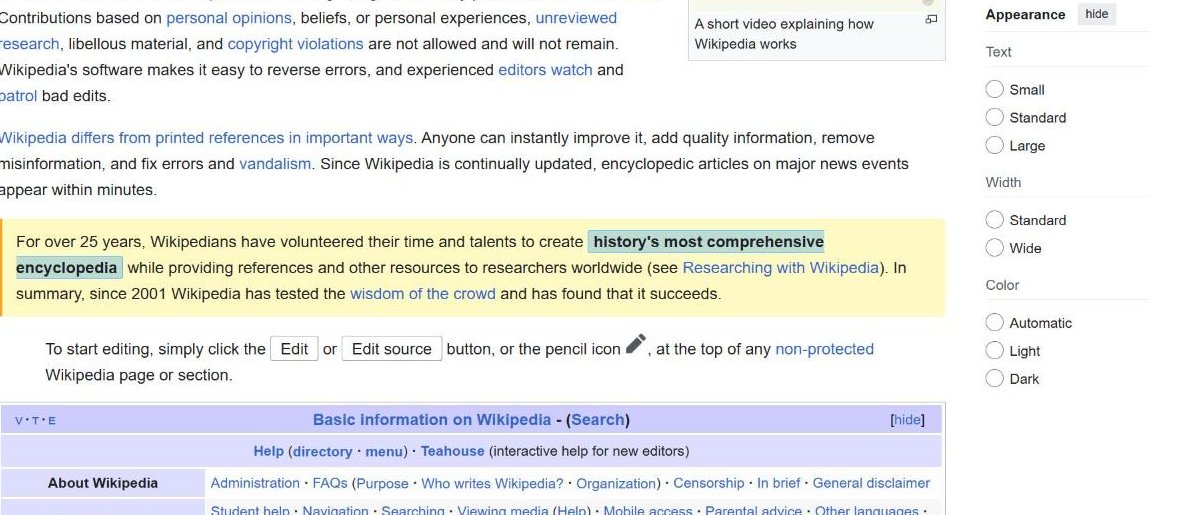
“Wikipedians have volunteered to create history’s most comprehensive encyclopedia… Experienced editors watch and patrol bad edits.”
But This Contradicts — Wikipedia:Medical Disclaimer
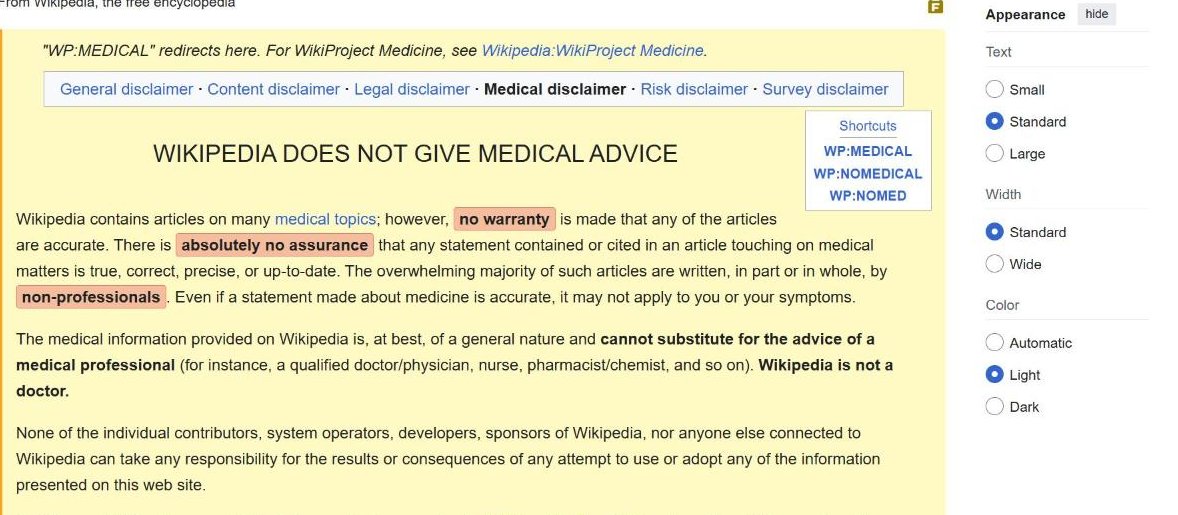
“WIKIPEDIA DOES NOT GIVE MEDICAL ADVICE… no warranty is made that any of the articles are accurate. There is absolutely no assurance… The overwhelming majority of such articles are written… by non-professionals.”
Why It Conflicts
You are comparing Wikipedia to an AI chatbot to decide which is more reliable. Wikipedia’s About page says experienced editors watch and patrol bad edits — implying a quality-control process. You choose Wikipedia. What you don’t see: its own Medical Disclaimer says there is “absolutely no assurance” medical articles are accurate, and they are mostly written by non-professionals. The Hasty et al. JAOA 2014 study (doi:10.7556/jaoa.2014.035) tested the 10 most costly medical conditions in the US and found statistically significant discordance between Wikipedia and peer-reviewed sources in 9 out of 10 cases. “Experienced editors watch” is a marketing claim. “Absolutely no assurance” is the legal disclaimer — and they contradict each other.
Who is affected: Students, patients, and professionals who use Wikipedia as a medical reference because it appears authoritative, comprehensive, and watched by experts.
Law / Governance at Risk
FTC Act Section 5 (15 U.S.C. § 45) — unfair or deceptive acts or practices — implied quality-seal claim without disclosed limitationGDPR Article 5 — accuracy, purpose limitation & storage limitation
Finding 4 of 12: Does Wikipedia use AI — and what did the 2026 LLM ban actually reveal?
Wikipedia Says — Wikipedia:About
“Wikipedia is written by human volunteers known as Wikipedians, not artificial intelligence.”
But This Contradicts — Wikipedia:Bots
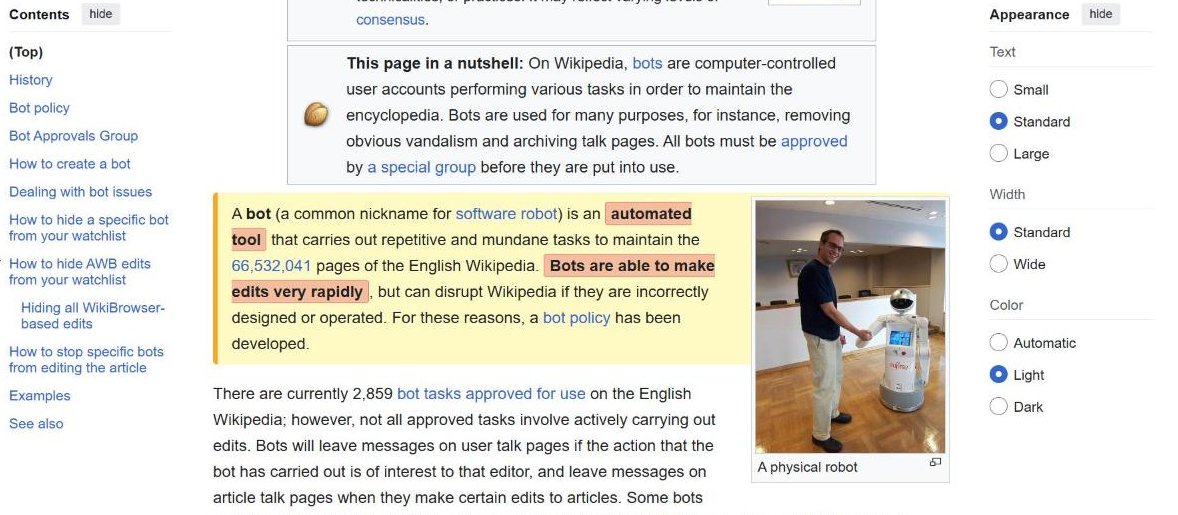
“A bot is an automated tool that carries out repetitive and mundane tasks… There are currently 2,859 bot tasks approved for use.”
Why It Conflicts
A journalist is fact-checking whether Wikipedia is human-written or AI-written. Wikipedia’s About page says flatly: written by humans, “not artificial intelligence.” The same domain’s Bots policy lists 2,859 approved automated tasks — bots that add content, fix links, categorize articles, and patrol edits without any human directly typing the words. In March 2026, English Wikipedia passed a guideline (WP:LLM, 44–2 vote) explicitly prohibiting the use of large language models to generate or rewrite article content. That rule was needed precisely because AI-generated content had already been getting in. The “not artificial intelligence” claim was not accurate before the rule, and the bot-task count proves it was always incomplete: automated systems have always been part of how Wikipedia works.
Who is affected: Journalists, AI developers, researchers, and regulators checking whether Wikipedia’s content is human-written — a critical question for training-data provenance, AI-Act compliance, and citation reliability.
Law / Governance at Risk
FTC Act Section 5 (15 U.S.C. § 45) — unfair or deceptive acts or practices — incomplete disclosure of content-generation methodsEU AI Act Article 50 — transparency obligations for AI-generated content — AI-generated content transparency obligations
EU AI Act Article 53 — training-data content obligations — training-data content obligations
Finding 5 of 12: Is Wikipedia biased — and what does its own Code of Conduct say about that?
Wikipedia Says — Universal Code of Conduct
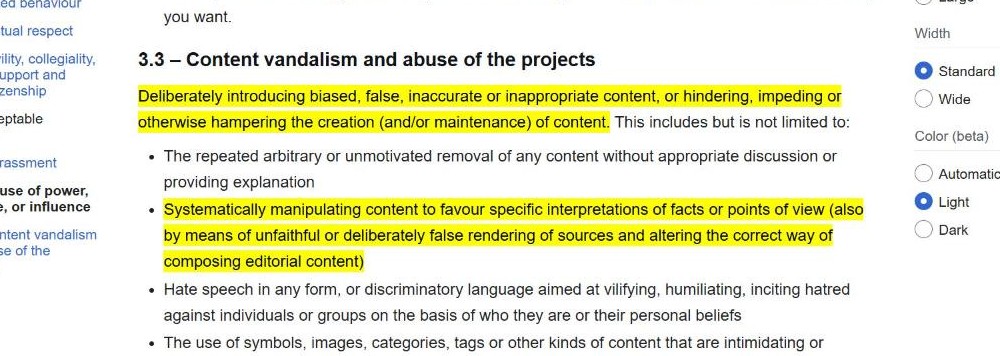
“3.3 – Content vandalism and abuse of the projects: Deliberately introducing biased, false, inaccurate or inappropriate content… Systematically manipulating content to favour specific interpretations of facts or points of view.”
But This Contradicts — Reliability of Wikipedia
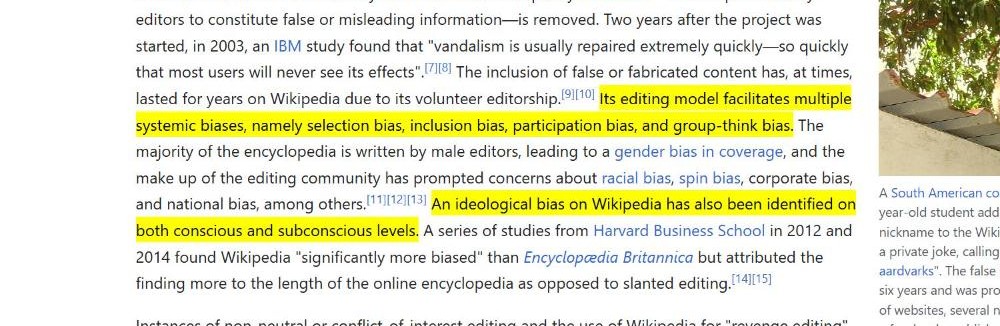
“Its editing model facilitates multiple systemic biases, namely selection bias, inclusion bias, participation bias, and group-think bias.” and “An ideological bias on Wikipedia has also been identified on both conscious and subconscious levels.”
Why It Conflicts
Imagine a Wikipedia editor who, without malice, only edits topics they care about — their own political or cultural community. They are not “deliberately” introducing bias; they simply contribute to what they know. Wikipedia’s Universal Code of Conduct bans “deliberately introducing biased, false, inaccurate or inappropriate content” and “systematically manipulating content.” But Wikipedia’s own reliability article says the platform’s bias is structural and subconscious — built into who edits, what gets covered, and how sources are selected. The Code of Conduct targets bad-faith actors. The reliability article documents that bias also comes from good-faith editors. No policy exists to address structural, systemic bias — the code only punishes deliberate misconduct. The 2026 PNAS study on Grokipedia vs. Wikipedia (Mohammadi & Yasseri, doi:10.1073/pnas.2603294123) found that even AI-generated encyclopedia alternatives show selective, topic-specific divergence in source citation leanings, particularly for religion, history, and literature — a pattern the study attributes to the underlying Wikipedia source pool both platforms draw from.
Who is affected: Researchers, students, journalists, and policy-makers who use Wikipedia as a background source on politically or culturally contested topics without knowing its own reliability article documents documented systemic bias.
Law / Governance at Risk
FTC Act Section 5 (15 U.S.C. § 45) — unfair or deceptive acts or practices — policy-vs-practice gap in a governance documentEU Digital Services Act (Regulation 2022/2065) — systemic risk assessment duties for VLOPs (Art. 34)
Finding 6 of 12: Does Wikipedia share your personal data with private companies?
Wikipedia Says — Wikimedia Privacy Policy
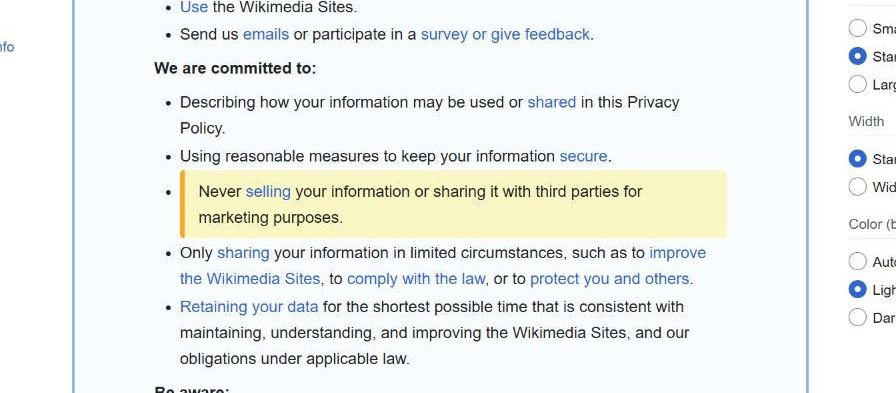
“Never selling your information or sharing it with third parties for marketing purposes.”
But This Contradicts — Wikimedia Privacy Policy
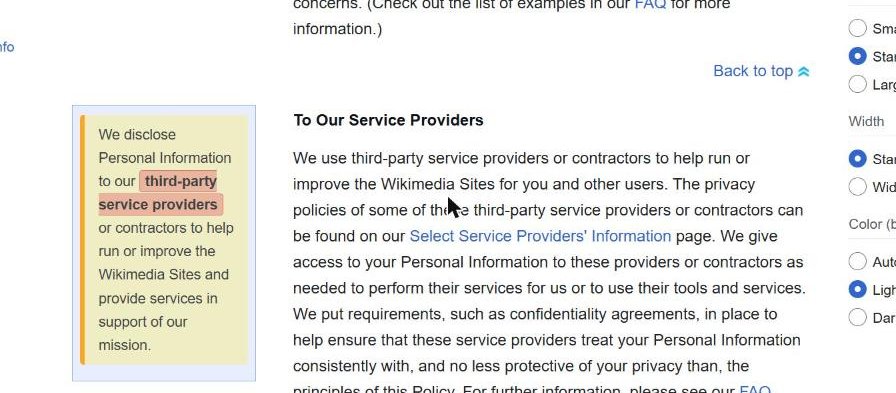
“We disclose Personal Information to our third-party service providers or contractors to help run or improve the Wikimedia Sites.”
Why It Conflicts
You read Wikipedia’s Privacy Policy before donating. It says “never selling your information or sharing it with third parties.” You feel safe. Later, you discover in another section of the same document that Wikipedia discloses your Personal Information to “third-party service providers or contractors.” The word “selling” in the promise was technically accurate — they are not selling it. But the absolute “never sharing with third parties” promise is immediately contradicted by the service-provider disclosure in the same document. If you read only the promise, you believe your data never reaches outside parties. If you read the whole document, you learn it does.
Who is affected: Anyone who reads Wikipedia’s donation or account privacy pages and relies on the “never sharing” promise to decide whether to donate, create an account, or edit without knowing their data goes to service providers.
Law / Governance at Risk
GDPR Article 17 — right to erasure (“right to be forgotten”) — right to erasureGDPR Article 5 — accuracy, purpose limitation & storage limitation — purpose limitation
California Consumer Privacy Act (CCPA) §1798.100 — right to know about data disclosure
Pages Involved
Wikimedia Privacy Policy (single document, two sections)Finding 7 of 12: Does Wikipedia honor your browser’s Do Not Track signal?
Wikipedia Says — Wikimedia Privacy Policy
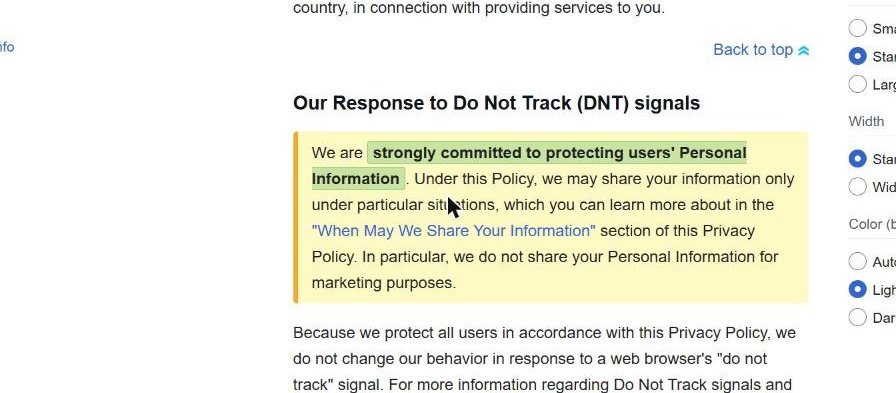
“We are strongly committed to protecting users’ Personal Information.”
But This Contradicts — Wikimedia Privacy Policy
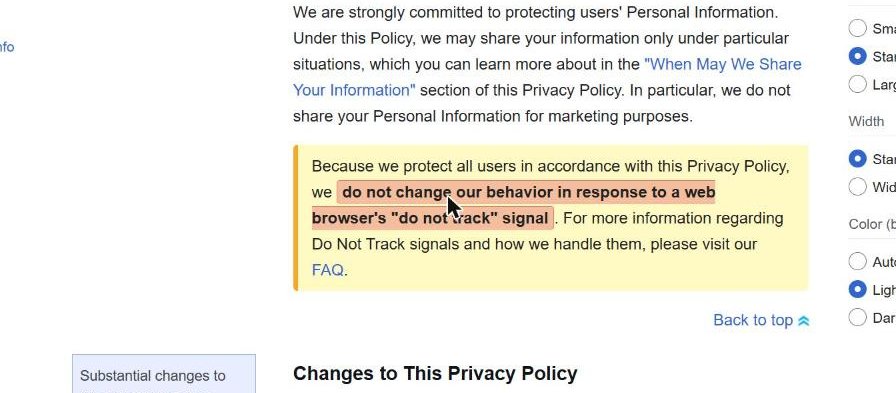
“…we do not change our behavior in response to a web browser’s ‘do not track’ signal.”
Why It Conflicts
You switch on Do Not Track in your browser — the privacy setting built into Chrome, Firefox, and Safari that asks websites not to track your activity. Then you visit Wikipedia. Wikipedia’s Privacy Policy says it is “strongly committed to protecting Personal Information.” But the same policy says it does not change its behavior in response to Do Not Track at all. Wikipedia’s stated reason: it protects all users equally, so it does not need to honor the signal. But if your browser sends a signal saying “do not track me” and the site ignores it, your personal data is still collected and your signal was silently dismissed. Under the California Consumer Privacy Act (CCPA), the Global Privacy Control — a legally binding version of DNT — must be honored. Wikipedia’s stated policy does not honor it.
Who is affected: Any Wikipedia reader in California (or under CCPA) whose browser sends a Global Privacy Control or Do Not Track signal — a legally recognized opt-out that Wikipedia’s own policy says it ignores.
Law / Governance at Risk
ePrivacy Directive 2002/58/EC Art. 5(3) — cookie and tracking consent — cookie and tracking consentCalifornia Consumer Privacy Act (CCPA) §1798.135 — Global Privacy Control must be honored
Pages Involved
Wikimedia Privacy Policy (single document)Finding 8 of 12: Can you delete your Wikipedia data under GDPR?
Wikipedia Says — Wikimedia Privacy Policy
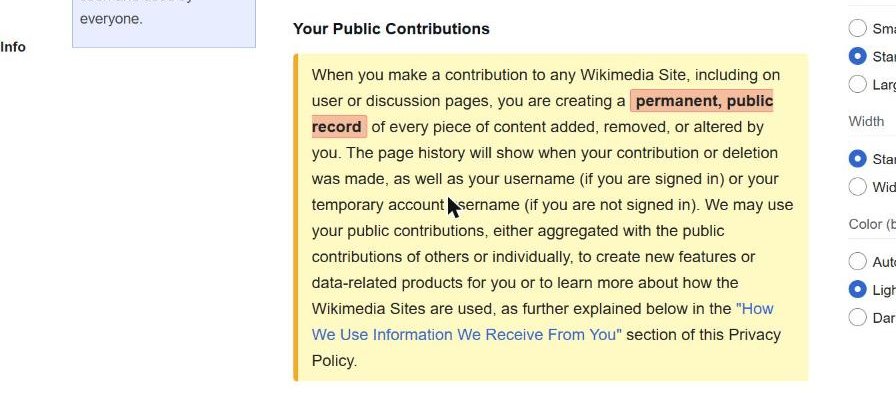
“When you make a contribution… you are creating a permanent, public record of every piece of content added, removed, or altered by you.”
But This Contradicts — GDPR Article 17
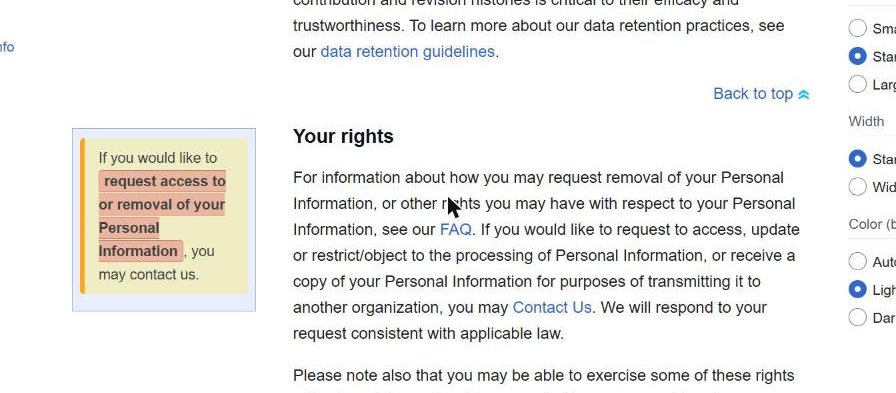
“The data subject shall have the right to obtain from the controller the erasure of personal data… without undue delay.”
Why It Conflicts
An EU resident edits Wikipedia using their real name as a username. Years later, those edits — with their username, timestamps, and content — still appear in the public edit history. They submit a GDPR Article 17 erasure request. Wikipedia’s response: it believes in a “Right to Remember,” and contribution histories are essential to its functioning. The Privacy Policy told them upfront their edit history was “permanent.” EU law says they have a right to erasure. Wikipedia’s own transparency reports show erasure requests regarding project content are largely declined and redirected to community volunteers. The word “permanent” in the Privacy Policy is in direct tension with the legal right to erasure — and the Foundation’s public position is that permanence wins.
Who is affected: Any EU or UK resident (or anyone under GDPR or UK GDPR) who has edited Wikipedia using an identifiable username and later wants their edit history removed under their right to erasure.
Law / Governance at Risk
GDPR Article 17 — right to erasure (“right to be forgotten”) — right to erasure (“right to be forgotten”)California Consumer Privacy Act (CCPA) §1798.105 — right to deletion
CJEU C-131/12 Google Spain v. AEPD (2014) — right to be forgotten
Pages Involved
Wikimedia Privacy PolicyFinding 9 of 12: How long does Wikipedia keep your data?
Wikipedia Says — Wikimedia Privacy Policy
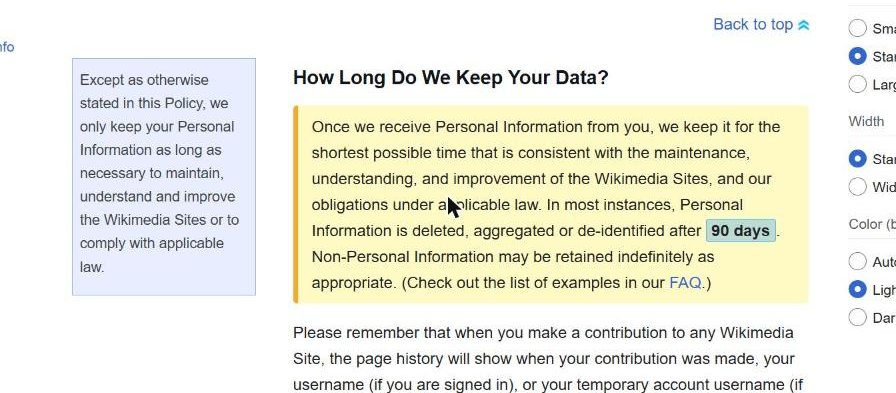
“In most instances, Personal Information is deleted, aggregated or de-identified after 90 days.”
But This Contradicts — Wikimedia Privacy Policy
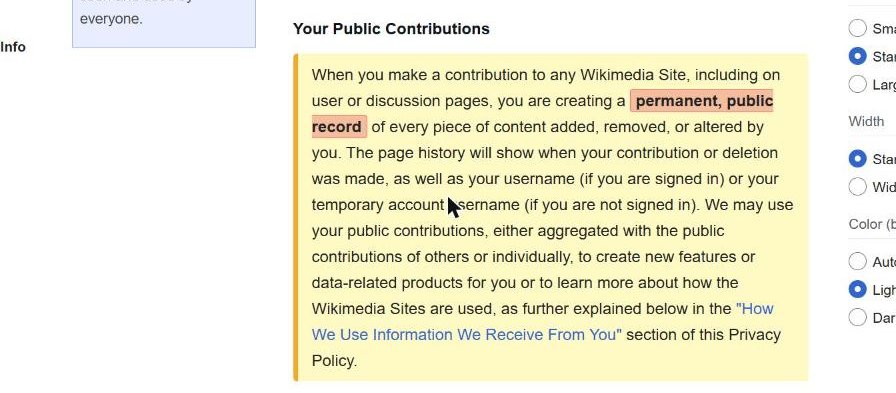
“When you make a contribution… you are creating a permanent, public record.”
Why It Conflicts
You donate to Wikipedia and wonder how long they keep your personal data. The Privacy Policy says: “in most instances, deleted after 90 days.” You assume that covers your Wikipedia activity. What you don’t realize: in a different section of the same document, it says every edit you make creates a “permanent, public record.” Your username, your edit timestamps, and what you changed are there indefinitely. The 90-day promise applies to server log data — not to contribution history. These two statements appear in the same document with no crosslink, no explanation of which applies when, and no disclosure of the legal basis for permanent retention. Under GDPR Article 5(1)(e), data may only be stored “for no longer than is necessary.” Permanent retention requires a justified legal basis — which is not stated.
Who is affected: Any Wikipedia editor or reader who reads the 90-day retention promise and believes it covers their edit history, only to discover those edits are permanently public.
Law / Governance at Risk
GDPR Article 5 — accuracy, purpose limitation & storage limitation — storage limitation principleGDPR Article 17 — right to erasure (“right to be forgotten”) — right to erasure
Pages Involved
Wikimedia Privacy Policy (same document, two sections)Finding 10 of 12: Can Wikipedia edits be traced back to you — does editing expose your IP?
Wikipedia Says — Wikimedia Privacy Policy
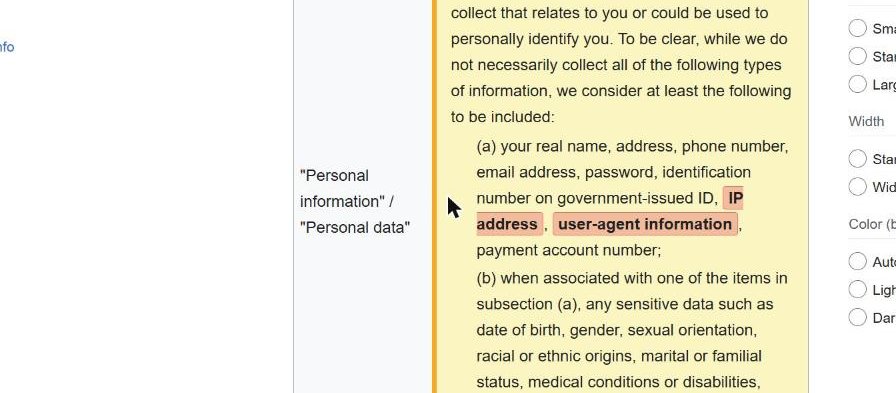
“Personal Information includes… IP address, user-agent information, payment account number”
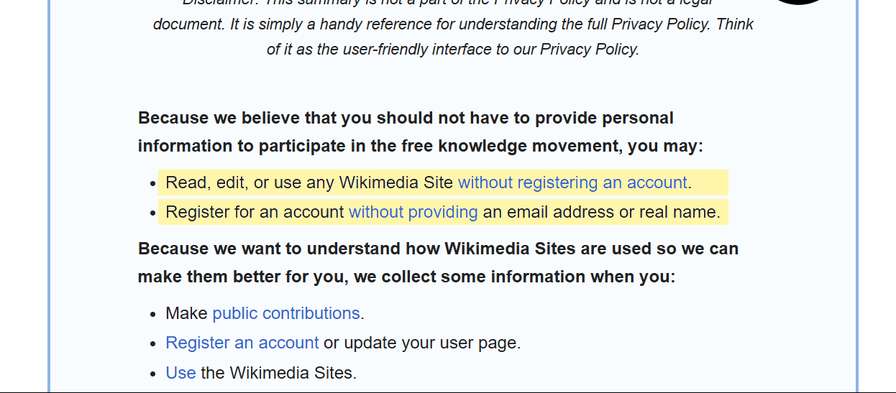
But This Contradicts — Wikimedia Privacy Policy
“you may: Read, edit, or use any Wikimedia Site without registering an account… without providing an email address or real name.”
Why It Conflicts
You edit Wikipedia without creating an account. You assume you are anonymous. The Privacy Policy says you can edit “without providing an email address or real name.” What it does not make clear upfront: the same policy classifies your IP address as Personal Information — and until November 4, 2025, that IP address was permanently visible in the public edit history for every edit you made. After November 4, 2025, unregistered edits now show a temporary account name (e.g., ~2025-31096-01) instead of your IP. However, administrators and “temporary account IP viewers” can still access the underlying IP address. And all IP edits made before November 4, 2025, remain permanently public in edit histories. Wikipedia’s anonymous-editing promise was always technically incomplete: “anonymous” meant your name was hidden, not your location.
Who is affected: Anyone who edits Wikipedia without an account believing they are anonymous — particularly activists, whistleblowers, domestic abuse survivors, or people in countries with authoritarian governments, whose IP address can identify their location.
Law / Governance at Risk
GDPR Article 6 — lawful basis for processing — lawful basis for processingGDPR Article 13 — information to be provided at collection — information must be provided at collection
GDPR Article 25 — data protection by design and by default — data protection by design
Finding 11 of 12: Does Wikipedia use third-party cookies or a TikTok pixel?
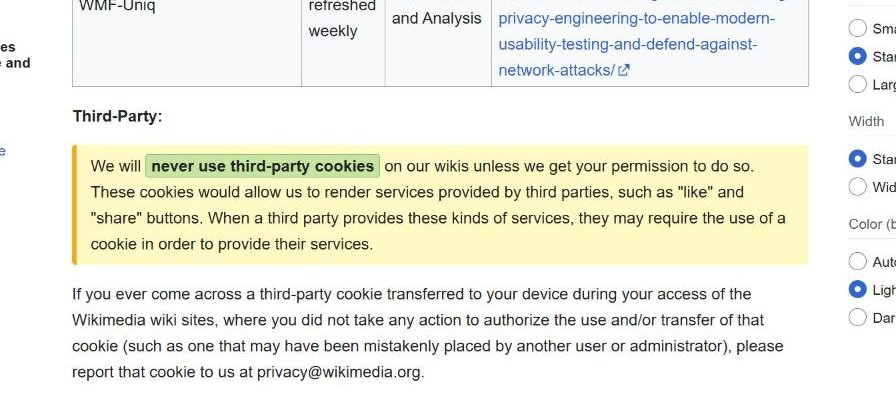
Wikipedia Says — Wikimedia Cookie Statement
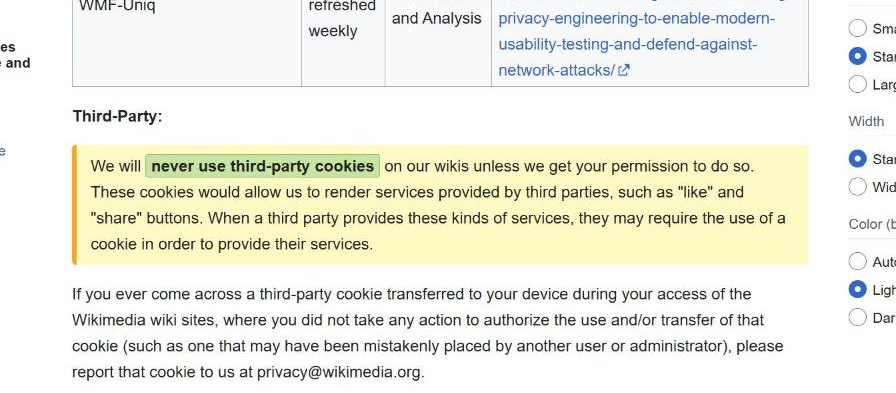
“We will never use third-party cookies on our wikis unless we get your permission to do so.”
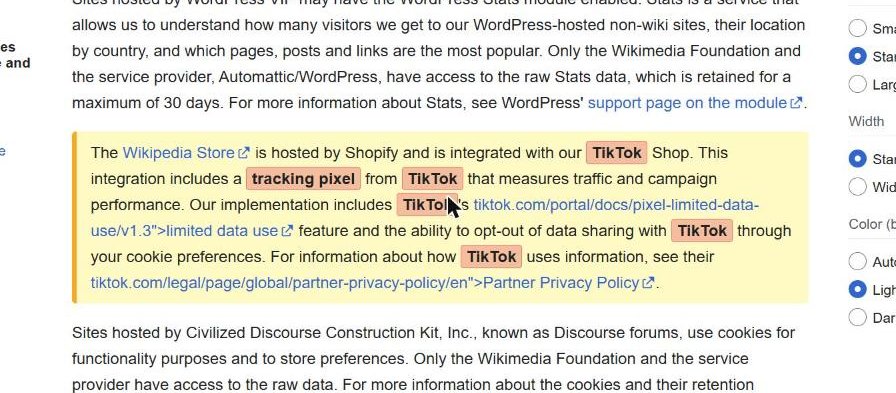
But This Contradicts — Wikimedia Cookie Statement
“The Wikipedia Store is integrated with our TikTok Shop. This integration includes a tracking pixel from TikTok.”
Why It Conflicts
You read Wikipedia’s Cookie Statement before clicking a Wikipedia Store link. It says: “We will never use third-party cookies on our wikis unless we get your permission.” You feel safe. Then you click through to the Wikipedia Store — a Shopify-hosted store that Wikipedia runs and which appears on the same Wikimedia domain. The same Cookie Statement you just read discloses that the Wikipedia Store is “integrated with our TikTok Shop” and “includes a tracking pixel from TikTok.” TikTok’s pixel transmits behavioral data — what you browsed, what you clicked — to TikTok’s servers, which are subject to EU–US data transfer restrictions and ePrivacy Directive consent requirements. The “never” promise applies to the wikis. The pixel runs in the Store. The same document makes both claims without clearly separating these contexts.
Who is affected: Anyone who visits the Wikipedia Store after reading the Cookie Statement’s “never third-party cookies” promise, unaware that TikTok’s pixel is running and transmitting behavioral data.
Law / Governance at Risk
ePrivacy Directive 2002/58/EC Art. 5(3) — cookie and tracking consent — third-party tracking requires explicit consentGDPR Article 7 — conditions for consent — conditions for valid consent
Pages Involved
Wikimedia Cookie Statement (single document)Finding 12 of 12: Are cookies required to read or edit Wikipedia?
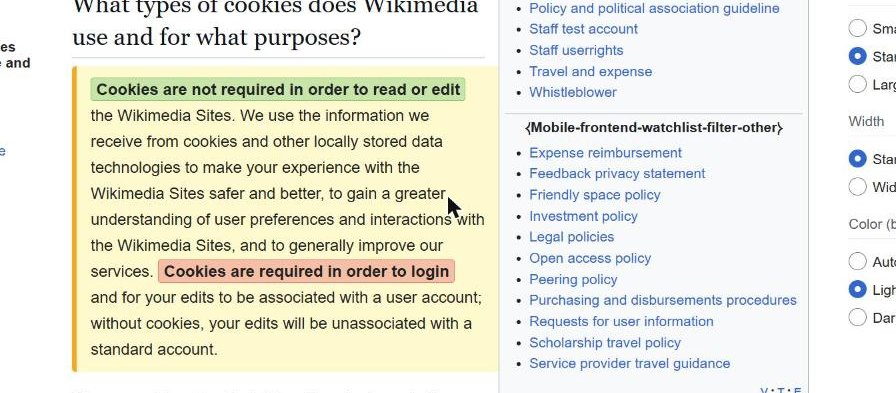
Wikipedia Says — Wikimedia Cookie Statement
“Cookies are not required in order to read or edit the Wikimedia Sites.”
But This Contradicts — Wikimedia Cookie Statement
“Cookies are required in order to login and for your edits to be associated with a user account.”
Why It Conflicts
You manage Wikipedia’s cookies in your browser privacy settings. You read the Cookie Statement to understand what you need to allow. Within the same paragraph, you see: “Cookies are not required in order to read or edit” — and immediately: “Cookies are required in order to login.” If you have an account and want your edits attributed to it, you need cookies. If you block all cookies, you can read but cannot log in. These are genuinely different scenarios — but the same paragraph gives contradictory statements without explaining which applies when. A privacy-conscious user who blocks cookies based on the “not required” statement will then discover their login no longer works. Under the ePrivacy Directive, only “strictly necessary” cookies may be set without consent — and to qualify, necessity claims must be accurate.
Who is affected: Privacy-conscious Wikipedia editors who attempt to manage cookies based on the “not required” statement and then discover that logging in does require them, without any warning that this would happen.
Law / Governance at Risk
ePrivacy Directive 2002/58/EC Art. 5(3) — cookie and tracking consent — strictly necessary cookie exemption requires accurate necessity disclosureGDPR Article 5 — accuracy, purpose limitation & storage limitation — transparency principle
Pages Involved
Wikimedia Cookie Statement (same paragraph)Frequently Asked Questions: Is Wikipedia Credible, Reliable, and Trustworthy?
These questions are answered using only Wikipedia’s own published policies and academic studies. Each answer includes the exact policy quote and the source page. Last verified: November 2026.
Sources & Evidence
The sources below are provided for checking the report against the underlying material. The report states an access period of November 2026; linked pages may subsequently change. Consult the full source and its revision history where available.
- Wikipedia:Medical Disclaimer“no warranty… written by non-professionals” — Findings 3
- Wikipedia:About“anyone can edit,” “quality over expertise,” “not AI” — Findings 1, 4, 2
- Wikipedia:General Disclaimer“NO GUARANTEE OF VALIDITY” — Finding 2
- Wikipedia:Bots“2,859 bot tasks approved” — Finding 4
- WP:LLM guideline (March 2026)English Wikipedia LLM ban, 44–2 vote — Finding 4
- Reliability of WikipediaSystemic bias, ideological bias, Pappas critique — Finding 5
- Universal Code of Conduct§3.3 bias and manipulation — Finding 5
- Wikimedia Privacy Policy“never selling,” third-party providers, DNT, 90 days, permanent record, IP address — Findings 6–10
- Wikimedia Cookie StatementTikTok pixel, “never third-party cookies,” cookie requirement — Findings 11–12
- Wikipedia:Temporary Accounts (Nov 2025)IP address access by administrators — Finding 10
- Wikimedia Temporary Account IP PolicyIP access limited to administrators and IP viewers; temporary accounts last up to 90 days — Finding 10
- Wikipedia: Seigenthaler biography incidentFalse biography; 132 days by Seigenthaler’s count — FAQ / Finding 2 context
- Hasty et al., JAOA 2014 — Wikipedia vs. peer-reviewed medical literature9/10 medical articles discordant with peer-reviewed sources — Findings 3. PubMed: PMID 24778001
- Mohammadi & Yasseri, PNAS 2026 — Selective divergence between Grokipedia and WikipediaGrokipedia cited more right-leaning news on religion, history, literature and art — Finding 5
- Giles, Nature 2005 — Wikipedia vs. Encyclopædia Britannica162 Wikipedia errors vs. 123 Britannica errors across 42 article pairs — Context
- GDPR Article 5Accuracy, purpose limitation, storage limitation
- GDPR Article 6Lawful basis for processing
- GDPR Article 7Conditions for consent
- GDPR Article 13Information at collection
- GDPR Article 17Right to Erasure — Findings 8, 9
- GDPR Article 25Data protection by design — Finding 10
- ePrivacy Directive 2002/58/EC Art. 5(3)Cookie and tracking consent — Findings 7, 11, 12
- EU AI Act Article 50AI transparency obligations — Finding 4
- EU AI Act Article 53Training-data content obligations — Finding 4
- EU DSA — Wikipedia VLOP Designation (Apr 2023)Wikipedia designated Very Large Online Platform — Finding 5, FAQ
- EU Digital Services Act (Regulation 2022/2065)Full DSA text
- FTC Section 5 — Federal Trade Commission ActProhibition on deceptive or unfair acts or practices
- California Consumer Privacy Act (CCPA)Official California AG page — Findings 6, 7, 8
- CJEU C-131/12 Google Spain v. AEPD (2014)Right to be forgotten — Findings 8, 9
- Supreme Court of Texas, 2017 — D Magazine Partners v. Rosenthal (Wikipedia as lynchpin of analysis)Court opinion, 17 March 2017 (corrected 29 September 2017)
- DOJ/FTC: Twitter $150M (May 2022)Finding 1
- FTC: Facebook (Meta) $5B (2019)Findings 3
- Ireland DPC: WhatsApp €225M (2021)Findings 3, 6
- Ireland DPC: Meta €390M (Jan 2023)Findings 6, 10
- 40 AGs: Google $391.5M (Nov 2022)Findings 2, 7
- UK ICO: TikTok £12.7M (Apr 2023)Finding 11
- Ireland DPC/EDPB: TikTok €345M (Sep 2023)Finding 11
- CNIL: Google + Facebook €210M (Jan 2022)Finding 12
- The audit screenshots reproduce Wikipedia and Wikimedia Foundation pages and are embedded within this HTML file for display. Base64 embedding does not prevent alteration or independently establish authenticity or capture dates.Source pages are linked directly in each finding above. Screenshots are presented for criticism and review; copyright exceptions depend on the particular use and applicable law. Wikipedia text is generally available under CC BY-SA 4.0, subject to source-specific notices; other material may have different terms. See the publication notice below for credits, licensing qualifications and correction requests.
- Hero image: Screenshot of wikipedia.org homepage, November 2026. Wikipedia® is a registered trademark of the Wikimedia Foundation, Inc.
- Published under Othakadai.com editorial policy and sources & methodology standards.
Purpose and independence. This independently published page by Arun Kumar Thiagarajan (Arun), site owner of Othakadai.com, is for information, public-interest commentary, criticism and review. It is not legal, medical or other professional advice, an official Wikipedia publication, or a judicial or regulatory finding. Neither Arun nor this website is affiliated with, sponsored by or endorsed by Wikipedia, the Wikimedia Foundation, or the organisations discussed.
Reading the analysis. Interpretations, severity labels and proposed fixes are the author’s assessments of the cited material. Describing a perceived conflict does not itself establish unlawful conduct, dishonesty or liability. Examples concerning other organisations do not establish wrongdoing by Wikimedia. Legal applicability depends on jurisdiction, facts, scope and exceptions; readers should consult the complete sources and qualified advisers where needed.
Credits for all screenshots, including the hero. The hero depicts Wikipedia.org; the audit screenshots depict the Wikipedia and Wikimedia pages linked beside each comparison and in the primary-source list above. Credit for the underlying text belongs to the respective page contributors; source-page histories identify contributors and revisions where available. Wikipedia text is generally available under CC BY-SA 4.0, subject to the applicable page notices. Wikimedia policy pages, photographs, logos and other media may carry different terms. No blanket licence or ownership claim is made over third-party material. Wikipedia names and marks belong to their respective trademark owner; their display identifies the material discussed, without implying endorsement. The footer’s rights reservation applies only to original material to the extent permitted by applicable licences.
Reuse and evidence limits. Screenshots are reproduced for contextual criticism and review. Any reliance on fair dealing under section 52 of India’s Copyright Act, 1957 is fact-dependent, not an automatic exemption. Where reuse relies on a Creative Commons licence, its attribution, licence-link and change-notice requirements apply. ShareAlike requirements apply to adaptations of the licensed material and do not automatically place the entire independent report under that licence. Applicable source-specific requirements remain relevant; see the Wikimedia Terms of Use and Trademark Policy. Source pages may change after capture. A screenshot records only the displayed excerpt, and base64 embedding alone does not authenticate it or prevent alteration. Any existing highlighting or cropping should be read alongside the linked full source.
Corrections, updates and rights concerns. If a source changes, an error is identified, or relevant context becomes available, this page may be corrected or updated following review. To suggest a correction, provide a response, or raise a copyright, attribution, privacy or other rights concern, please contact Arun through the website’s Contact page with the page URL, finding number, disputed wording or image, supporting evidence and requested remedy. Please avoid sending unnecessary sensitive personal information. Substantiated concerns can be addressed through clarification, correction, attribution, updating or removal as appropriate. Material corrections will be identified with a revision note and update date. Contacting the publisher is an invitation, not a condition for exercising legal rights.
Publisher and contact. Arun Kumar Thiagarajan — Othakadai.com, Madurai, Tamil Nadu, India. Publication date: 13 November 2026. For editorial enquiries, corrections and legal notices, use the Contact page. Publication from India does not by itself determine every applicable law or jurisdiction.
Scope of this notice. This notice does not certify every claim as accurate, guarantee compliance with every law or platform guideline, waive anyone’s rights, or exclude liability that cannot lawfully be excluded.